 Let's Talk ↗
More of your customers are skipping Google and asking ChatGPT, Gemini, Claude or Perplexity who to use. They get two or three names back, not ten links. We make sure yours is one of them.
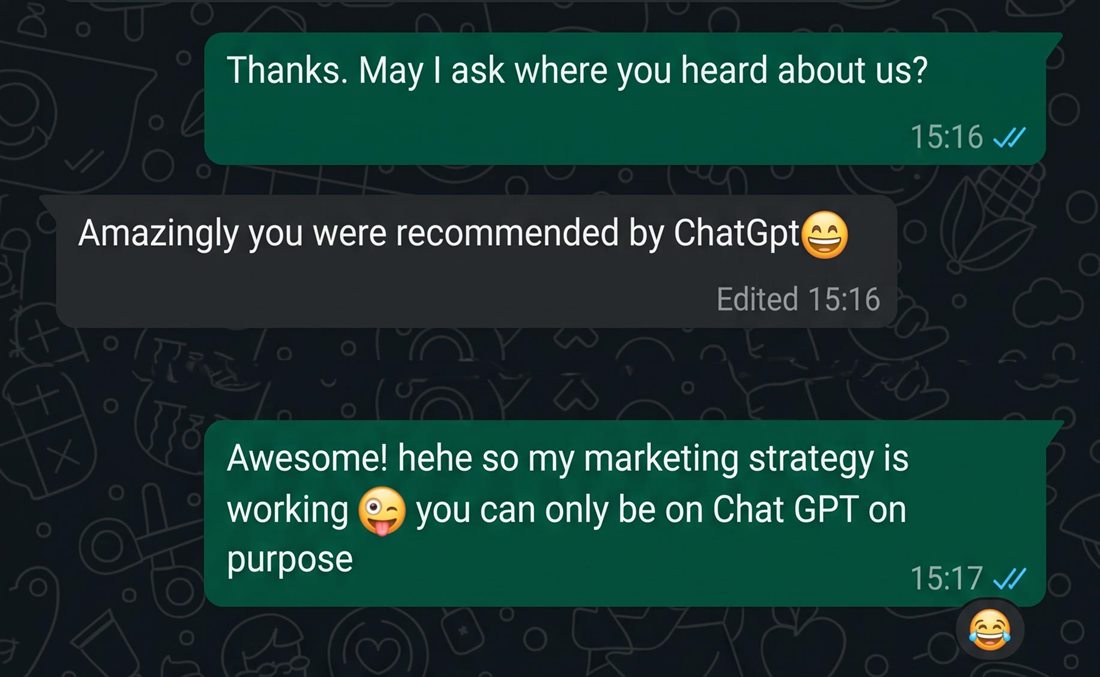
This is a real WhatsApp from a new enquiry. We asked where they'd heard about us. Their answer: ChatGPT recommended us.
We didn't pay for that mention and we didn't get lucky. It came from the same groundwork on our own website that we'll do on yours. It's not a guarantee (nobody can give you one), but it's proof the work does what it says.
On a results page you could sit at number seven and still get the click. In AI search there's no page two. The assistant reads the web, decides who it trusts, and names a handful of businesses. Everyone else is invisible for that question. If your website hasn't had this update, that might be you.
Ten blue links, then the customer clicks around and compares.
A short answer with a few names, often with a reason attached. If you're not in it, the customer may never know you exist.
Nobody outside these companies knows the exact recipe, and it changes often. But the signals they lean on are no secret. If the answer to all four is yes, you're in a strong spot.
Your site lets AI crawlers in, loads fast and keeps the important words in the page, not locked in images, PDFs or pop-ups.
Your name, address, services and area are clear and match everywhere, with structured data spelling it out for machines.
Reviews, directory listings, local news, blogs and industry lists. AI trusts what other people say about you more than what you say.
Your content answers what real customers ask, in plain words, so the assistant can lift it straight into its reply.
AI visibility, AI SEO, GEO, AEO: the names keep changing, the job doesn't. It's a handful of unglamorous jobs done properly and kept up. Here's what's included.
We ask ChatGPT, Gemini, Claude, Perplexity and Google's AI Overviews the questions your customers ask. We log who gets named, which sites get cited and what the AI says about you. That's where we start.
Schema markup for your business, services, people and FAQs, plus one consistent name, address and phone number across Google, Facebook and directories. Machines stop guessing who you are.
Pages and FAQs built around the real questions people ask about your trade, written by people in your voice. Clear enough for a customer to skim and for an AI to quote.
We check your robots.txt isn't quietly blocking GPTBot, ClaudeBot or PerplexityBot, and write a proper llms.txt profile of your business. It's a new standard and not every AI reads it yet, but it's cheap and it helps the ones that do.
A simple system for getting honest reviews, the directory listings that matter in your industry, and pitches to local media, podcasts and lists. The places AI reads when it decides who to trust.
Every month we ask the same questions again and show you what moved: where you're named, where you're not, and what we're doing about it. In plain English, no dashboards to decode.
In September 2026 Google started moving a lot of Search campaigns onto AI Max, its AI-run version of Google Ads, automatically. If your campaigns used broad match or auto-created ads, you may have been switched over without noticing.
Here's the part nobody mentions: AI Max builds a lot of your ads from your website. Google's own help pages say it writes headlines and descriptions from your landing pages, chooses which page people land on, and uses your site content to find searches to show you for.
So a vague or outdated website costs you twice. AI assistants leave you out of their answers, and Google's ad AI writes weaker ads, matches you to the wrong searches and spends your Rands on the wrong people. And you're responsible for whatever it writes.
The fix is the same work. A clear, well-structured, up-to-date website gets you named by AI and gives Google's ad AI something good to work with. Read more about the Google Ads change ↗
Not on page two. Not anywhere. AI assistants simply name someone else, and Google's ad AI works with whatever your site gives it. There's no warning and no notification. The only way to know is to check.
Take the 2-minute check ↓Eight honest questions. Not sure? Pick "not sure" and move on. Nothing is saved or sent anywhere, this is just for you.
Same four steps for a guesthouse in Knysna or a law firm in Sandton. What changes is the questions we ask and where we look for mentions.
We put your customers' real questions to the main AI assistants and record exactly where you stand today.
Crawler access, structured data, consistent business details and the pages that answer the big questions.
Reviews, listings and mentions on the sites AI already trusts, so it isn't only your website vouching for you.
Same questions, every month. You see what changed, and we keep adjusting until you're part of the answer.
No one can promise that ChatGPT will name you next week. These tools change all the time, two people asking the same thing can get different answers, and nobody outside OpenAI, Google or Anthropic controls them.
If someone guarantees you a top spot in AI answers, walk away.
What we can do is make your business the clearest, best-documented and most trusted option out there, then show you every month whether it's working. It's the same groundwork that helps your Google rankings, so none of it is wasted.
It's how often, and how well, AI assistants like ChatGPT, Google Gemini, Claude and Perplexity mention your business when people ask them for a recommendation. You'll also hear it called AI SEO, GEO (generative engine optimisation) or AEO (answer engine optimisation). The goal is the same: when someone asks AI who to use, your name is in the answer.
Make it easy for ChatGPT to find you, understand you and trust you. That means a website its search crawler can read, the same business details everywhere, a complete Google Business Profile, recent reviews, pages that answer real customer questions, and other reputable sites mentioning you. Then keep asking ChatGPT your customers' questions to see if it's working.
SEO gets your website ranking on Google. AEO, answer engine optimisation, shapes your content so search engines and voice assistants can lift it as a direct answer. GEO, generative engine optimisation, is about being named and cited by AI tools like ChatGPT and Gemini. They overlap a lot, and a good AI SEO plan covers all three.
Yes. Good SEO is part of the foundation, because many AI tools search the web before they answer. But AI also leans heavily on what other sites say about you, how consistent your business details are, and whether your content answers questions directly. So we do the SEO basics and then go further.
You may simply not be mentioned. AI assistants name the businesses they can read, understand and trust, and quietly leave the rest out. There's no ranking report for it, so most businesses only find out when they check.
Yes. Since September 2026 Google has been moving many Search campaigns onto AI Max, which uses your website to help decide which searches to show your ads for, writes ad text from your landing pages and picks which page people land on. A clear, up-to-date website gives it better material. A vague one means weaker ads and wasted spend.
No, and nobody honestly can. AI answers change often and can differ from one person to the next. What we can do is fix everything within reach that makes AI more likely to name you, and show you every month where you're being mentioned.
AI tools that search the web live can pick up changes within a few weeks. Answers that come from a model's built-in knowledge update less often, so those can take months. We track both and report on them monthly.
ChatGPT, Google Gemini and Google's AI Overviews, Claude, Perplexity and Microsoft Copilot. We focus on the ones your customers actually use.
Every business starts from a different place, so we quote individually. We look at where you stand first, then come back with a clear scope and price. No lock-in surprises.
Not sure where your website stands? Run it through our free site audit first, or tell us about your business and we'll come back with a plan.
No pressure. No jargon. Just a straight conversation about your business and what you want to achieve. We'll come back with a plan, a price and a timeline.